About ontinuous Emission Surveillance Platform
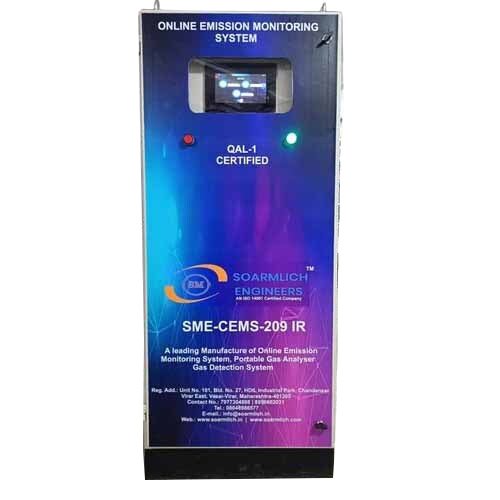
The Online Continuous Emission Monitoring System (CEMS) is an advanced, automatic solution for real-time stack monitoring. Designed for industrial compliance and precision, it features a fast 1-second (T90) response time and +1% F.S. linear error for accurate readings. Operates on 230V AC power with 2x4-20mA analog input/output for seamless integration. Its IP66-rated blue enclosure ensures durability in harsh environments. Ideal for continuous emission tracking, the system offers reliable data for regulatory reporting and environmental safety, making it essential for modern emission control applications.
| Machine Type | IN-Situ |
| Model Name/Number | SME-100 |
| Brand | Soarmlich Engineers |
| Product Type | CEMS |
| Power Supply | 230V AC |
| Usage/Application | Stack Monitoring System |
| Color | Blue |
| Automation Grade | Automatic |
| Response Time | 1s (T90) |
| Analog Output | 2x4-20mA Output |
| Analog Input | 2x4-20mA input |
| Enclosure Rating | IP66 |
| Linear Error | +-1%F.S. |
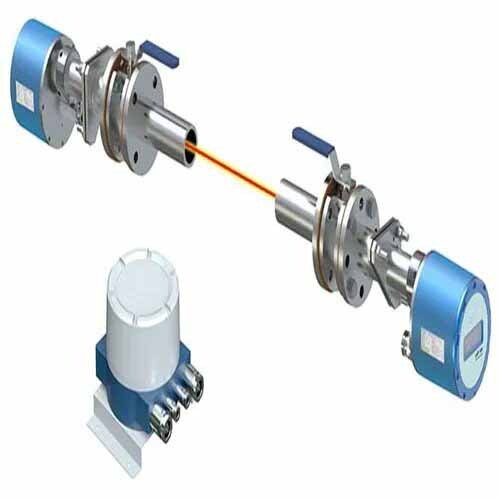
Advanced In-Situ Monitoring TechnologyThis platform utilizes in-situ TDLS measurement, capturing precise SOx emission data directly from within the stack. Its rapid response and continuous monitoring capabilities make it ideal for operations that demand up-to-the-minute environmental compliance. The stainless steel construction ensures protection against harsh elements, promoting longevity and reliability in industrial settings.
Seamless Integration and AutomationEquipped with versatile outputs-dual analog 4-20mA and RS485 digital-the platform integrates effortlessly with a wide range of control and data acquisition systems. Its fully automatic operation minimizes manual intervention, streamlining the environmental compliance process for manufacturers, suppliers, and exporters.
Robust Performance in Demanding EnvironmentsEngineered for durability, the IP66 enclosure protects the instrument from dust, water, and corrosive gases commonly present in industrial stacks. It remains highly accurate and efficient within temperatures from -10C to 50C, ensuring uninterrupted emissions monitoring even under rigorous conditions.
FAQ's of ontinuous Emission Surveillance Platform:
Q: How does the Continuous Emission Surveillance Platform measure SOx emissions?
A: The platform uses advanced Tunable Diode Laser Spectroscopy (TDLS) to provide in-situ measurement of SOx gases directly within industrial stacks. This allows for accurate, real-time data collection without gas sampling, ensuring reliable and consistent monitoring.
Q: What are the key benefits of using this stack monitoring system in industrial applications?
A: The system offers continuous, automatic monitoring with a fast 1-second response time and high accuracy. Its robust IP66-rated enclosure and stainless steel construction guarantee durability in harsh environments, helping factories consistently meet emission regulations and environmental standards.
Q: When is this surveillance platform typically installed and operational?
A: It is commonly installed during new stack setups or as upgrades to existing emission management systems. Once integrated, it operates continuously, delivering real-time emission data to support compliance and process optimization.
Q: Where can this platform be deployed for effective emission monitoring?
A: Designed for versatility, the platform is deployed in industrial stacks and chimneys across sectors like power plants, refineries, and chemical manufacturing facilities. Its IP66 enclosure ensures reliable operation indoors and outdoors.
Q: What is the process for integrating the emission platform with existing control systems?
A: The device provides RS485 digital outputs and dual analog (4-20mA) outputs for easy integration with distributed control systems (DCS) or PLCs. This plug-and-play capability allows for seamless data transfer and centralized monitoring.
Q: How is the platform used, and what operational support does it require?
A: Once installed, the platform operates automatically, needing minimal intervention. Routine inspections ensure continued accuracy, while built-in automation handles real-time measurement and data output.
 Chat with us


 Send Inquiry




 Send Inquiry
 Send Inquiry
 Send SMS


